How Zirconia Oxygen Analyzers Support Boiler Combustion Monitoring
Stable combustion is of course key to boiler performance, emissions and reliable operation. A zirconia oxygen analyser is used to measure the oxygen in the flue gas and provides the operator with a good indication of the amount of excess air in the combustion.
With the right measurement point and control strategy, oxygen readings can be of value in boiler monitoring and can assist the operator in identifying changes in combustion. This blog looks at how zirconia oxygen analyzers work and what you need to consider when using them on a boiler.
How a zirconia oxygen analyzer works
A zirconia oxygen sensor uses a heated ceramic element to measure the difference in oxygen concentration between the flue gas and a reference gas. That difference generates an electrical signal which the analyzer then converts into an oxygen reading.
Depending on the instrument design, the sensor can be installed either directly in the flue gas stream or as part of a sample system. An in-situ arrangement will be measuring at the point of installation, so the probe location and the conditions at that location are of importance.
How oxygen readings support boiler combustion monitoring
Boiler operators can use the oxygen reading as one of their inputs when assessing boiler combustion. A change in the oxygen reading may indicate a change in air supply, fuel feed, load or operating conditions. The reading can be used to help the operator investigate the change and make the appropriate adjustments in accordance with the boiler operating procedures.
Oxygen monitoring can also be used to support boiler combustion controls. If the readings are fed into a suitable control system, they can be used to make air/fuel adjustments. The analyser provides the measurement; the control system and the operating strategy decide what to do with it.
Potential benefits for boiler operation
A properly selected and maintained zirconia analyser can help teams:
- Monitor oxygen levels during changing boiler loads.
- Observe trends that may indicate a change in combustion conditions.
- Support air-to-fuel adjustments as part of an established control strategy.
- Compare readings before and after maintenance.
- Record oxygen data for operational review.
O2 readings must be interpreted in conjunction with other pertinent information such as fuel type, boiler load, CO readings and operating procedures. O2 by itself is not a complete picture of combustion.
Choosing an analyzer for a boiler
Before selecting a zirconia oxygen analyser, review the boiler and installation requirements:
- Measurement range: Ensure the analyser’s range covers the anticipated operating conditions.
- Installation point: Select a location that will give a representative reading and which is appropriate for the probe.
- Process conditions: Ensure that the sensor and probe are appropriate for the flue temperature, pressure, dust and gas conditions.
- Response and output: Check the response time, the display and the available outputs for the monitoring or control system.
- Maintenance: Check calibration/verification procedures, cleaning requirements and access for service.
- Integration: Confirm the analyser output is compatible with the plant’s monitoring and/or control equipment.
The probe must be appropriate for the installation environment. Check the manufacturer’s specifications on operating limits prior to installation.
In-situ measurement and installation
An in-situ zirconia oxygen analyser simply puts its probe in the flue and takes the reading at the point of installation. That can be a perfectly viable option for continuous monitoring as long as the location chosen is one which gives a representative reading and the probe is capable of coping with the process conditions.
Installation planning must take into account access, orientation, flue flow, dust and maintenance. A bad location can result in readings which don’t in any way reflect the actual operation of the boiler. You must of course follow the manufacturer’s installation instructions and the site’s safety procedures.
Maintenance and reliable readings
Regular maintenance will keep the readings useful. The operator should adhere to the manufacturer’s instructions for inspection, cleaning, calibration or verification and for sensor replacement. They should also check that the probe and the electrical connections are in good condition.
If a reading seems odd, check it against the boiler load, the fuel and air settings, the other gas readings and the recent maintenance prior to changing the controls.
Conclusion
Zirconia oxygen analysers can be used to provide oxygen measurements for boiler combustion monitoring and boiler combustion controls. Their usefulness of course is entirely dependent on selecting the right analyser, installing it at a suitable location and maintaining it in accordance with the manufacturer’s instructions.
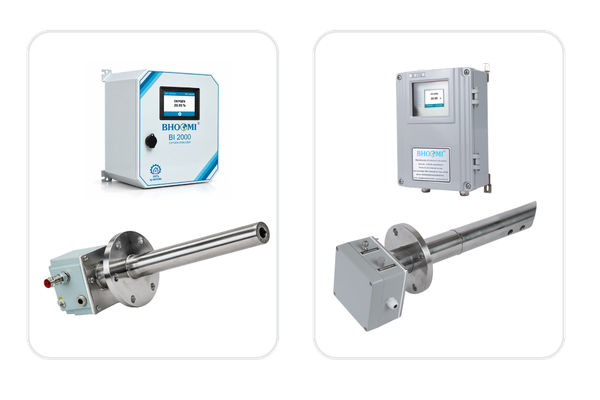
Bhoomi offers zirconia oxygen analyser solutions for process monitoring. The BI 2100 is an in-situ probe configuration and the BI 2000 is a wall mount configuration. Get in touch with Bhoomi with your boiler conditions, installation details and monitoring requirements to discuss the appropriate configuration.